

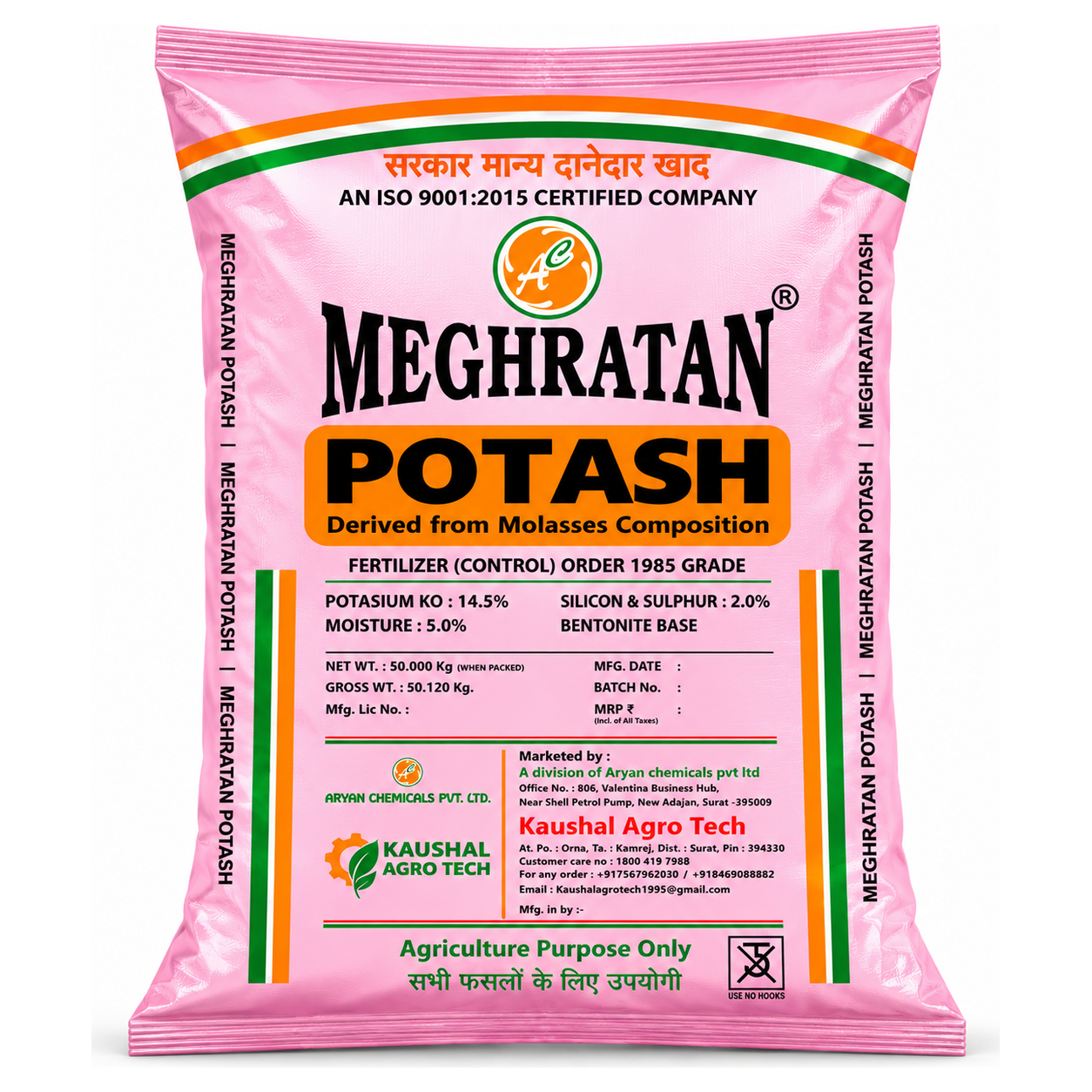
MEGHRATAN POTASH
Meghratan Potash is a molasses-based fertilizer containing potassium, silicon and sulphur, formulated to support crop nutrition and healthy plant growth. Available in a convenient 50 kg pack.
Description
MEGHRATAN POTASH – Potassium Fertilizer for Balanced Crop Nutrition
Meghratan Potash is a potassium-based fertilizer formulated to support
the potassium requirement of crops and promote balanced plant nutrition. Potassium is an
essential macronutrient that helps regulate several physiological processes, including
water balance, nutrient movement, enzyme activity and the transport of carbohydrates
from leaves to developing plant parts.
Adequate potassium nutrition can contribute to healthy root development, better
water-use regulation and improved crop quality. Potassium is particularly important
during crop stages when plants are actively developing flowers, fruits, grains,
tubers or other harvestable parts.
Meghratan Potash can be incorporated into a
balanced fertilizer program according to the crop, soil condition
and recommended nutrient requirements.
What Nutrients Does Meghratan Potash Contain?
The primary nutrient supplied by Meghratan Potash is
Potassium (K).
Potassium is one of the three major macronutrients required by plants:
- N – Nitrogen:
Supports vegetative growth. - P – Phosphorus:
Supports root development and energy-related processes. - K – Potassium:
Supports water regulation, nutrient transport, enzyme activity and crop development.
Plants absorb potassium primarily in the K⁺ form. Unlike nitrogen
and phosphorus, potassium does not become a structural component of plant tissues;
instead, it performs important regulatory functions inside the plant.
The exact potassium percentage or grade should be added according to the official
Meghratan product label or FCO specification.
What Is Potash and How Does It Help in Crop Nutrition?
Potash is a common agricultural term for potassium fertilizers
used to supply crops with potassium. Potassium is essential for maintaining proper
plant water relations, nutrient transport and several metabolic processes.
Potassium is important for:
- Regulating water balance within plant cells
- Supporting stomatal function
- Improving movement of water and nutrients
- Supporting root growth
- Activating numerous plant enzymes
- Supporting carbohydrate formation and movement
- Contributing to fruit, grain, tuber and other harvest quality characteristics
Potassium also contributes to the transport of photosynthates from leaves to
reproductive and storage organs such as fruits, grains and tubers.
Adequate potassium nutrition can therefore be an important part of crop nutrient
management.
Benefits of Meghratan Potash for Farmers
When used as part of a balanced, soil- and crop-specific nutrient management program,
Meghratan Potash can help farmers provide crops with an adequate supply of potassium.
1. Supports Balanced Crop Nutrition
Potassium works together with nitrogen and phosphorus to support overall plant
growth and development.
2. Helps Improve Water Regulation
Potassium plays an important role in water relations and stomatal regulation,
helping plants manage water movement and loss.
3. Supports Nutrient Transport
Potassium contributes to the movement of water and nutrients through the plant
and supports efficient translocation of important compounds.
4. Supports Root Development
Adequate potassium nutrition is associated with improved root growth and can
help crops cope with periods of water stress.
5. Supports Flowering and Fruit Development
Potassium is important for the transport of photosynthates to reproductive
and storage organs, making potassium nutrition relevant during flowering,
fruit development and yield formation.
6. Helps Support Crop Quality
Adequate potassium nutrition is associated with important quality characteristics
in crops. In fruits and vegetables, potassium contributes to characteristics such
as fruit size, colour, taste and storage quality.
7. Supports Crop Performance Under Water Stress
Because potassium is involved in plant water relations and stomatal regulation,
maintaining adequate potassium nutrition can support plant responses to water stress.
Which Crops Can Use Meghratan Potash?
Potassium is required by a wide range of agricultural and horticultural crops.
Meghratan Potash can be considered as a potassium source for crops where potassium
is required as part of the recommended nutrient-management program.
Field & Cereal Crops
- Rice / Paddy
- Wheat
- Maize
- Sorghum
- Bajra / Pearl Millet
Pulses & Oilseeds
- Groundnut
- Soybean
- Cotton
- Chickpea
- Green Gram
- Black Gram
Vegetable Crops
- Potato
- Tomato
- Onion
- Chilli
- Brinjal
- Okra
- Cabbage
- Cauliflower
- Cucurbits
Fruit & Plantation Crops
- Banana
- Mango
- Grapes
- Citrus
- Pomegranate
- Papaya
- Watermelon
- Muskmelon
Potassium requirements vary significantly between crops, varieties, soil types
and growth stages.
When Is Potassium Important for Crops?
Potassium demand can be particularly important during periods of active crop
development, including:
Vegetative Growth → Flowering → Fruit/Grain Formation → Crop Maturity
Providing adequate potassium during the appropriate crop stage helps support the
plant’s water regulation, nutrient movement and translocation of photosynthates
toward developing harvestable parts.
The actual timing and quantity should be determined according to
soil-test results, crop requirements and locally recommended fertilizer practices.
Why Choose Meghratan Potash?
Meghratan Potash helps farmers address the potassium requirement of their crops
as part of a balanced crop nutrition program. By supplying potassium, it supports
important plant functions related to water management, nutrient movement, root
development, crop development and quality.
For best results, potassium should not be viewed in isolation.
Balanced NPK nutrition and soil-test-based fertilizer management
are important for maintaining crop productivity and soil health.
Application & Usage
Recommended application:
Use Meghratan Potash according to the crop’s potassium requirement,
soil-test recommendations and the dosage specified on the product label.
Application method:
Application may depend on the product grade, crop and farming system,
and can include soil application or other approved application methods
where applicable.
Do not use a fixed dosage across all crops. Fertilizer quantity and application
timing should be based on the product label, soil-test results, crop stage and
recommendations from qualified agricultural experts.
Frequently Asked Questions About Meghratan Potash
What is Meghratan Potash?
Meghratan Potash is a potassium-based fertilizer designed to provide crops with
potassium as part of a balanced crop nutrition program.
What nutrient does potash provide?
Potash primarily supplies potassium (K), an essential plant
macronutrient involved in water regulation, nutrient transport, enzyme activation
and crop development.
What are the benefits of potassium fertilizer?
Potassium fertilizer helps support water regulation, nutrient movement, root growth,
enzyme activity and the transport of photosynthates to developing fruits, grains
and tubers.
Which crops need potash fertilizer?
Many crops require potassium, including rice, wheat, maize, cotton, groundnut,
soybean, vegetables, fruits and other field and horticultural crops. The actual
potassium requirement depends on the crop and soil condition.
Is potash good for fruit crops?
Potassium is an important nutrient for fruit crops because it supports water
regulation and the movement of photosynthates to reproductive and storage organs.
Adequate potassium nutrition is also associated with fruit quality characteristics.
When should potassium fertilizer be applied?
The appropriate application stage depends on the crop, soil condition and fertilizer
grade. Potassium should be applied according to soil-test recommendations and the
crop’s nutrient requirement.
Can potash be used with other fertilizers?
Potassium is commonly included as part of balanced NPK nutrition. Compatibility
with specific fertilizers or application methods should be confirmed from the
product label and technical recommendation.



Reviews
There are no reviews yet.